
A Sub-Zero rarely dies all at once. It drifts. Temperature creeps up a few degrees, the compressor runs longer, the ice cream goes soft, and by the time the alarm light is on the unit has been struggling for days. The good news: most Sub-Zero cooling problems are not the expensive ones. Here is how to read it.
We are Bay Area Appliance Repair Service, an all-brand shop across the Bay Area, and Sub-Zero is on our regular call sheet.
Start with the five-minute checks
Before you call anyone, rule out the easy stuff:
- Door seal. Close the door on a dollar bill and pull. If it slides out with no drag, the magnetic gasket is weak and warm air is leaking in.
- Vacation or showroom mode. A bumped panel can drop the unit into a reduced-cooling mode. Check the display against the manual.
- Condenser dust. On built-in 600 and 700 series units the coil sits behind the top grille. Pull it, vacuum the coil and fan area with a brush head, and give it a day. A coil packed with dust and pet hair is the single most common reason a Sub-Zero loses cooling.
- Inside airflow. Boxes jammed against the rear vents block the cold-air return. A Sub-Zero leans on tight internal airflow more than a cheap fridge does.
Seal good, coil clean, still not holding temperature? The problem is mechanical, and that is where a tech comes in.
The condenser fan
Behind that top grille is a fan pulling air across the coil. When its motor fails or seizes, the unit cannot reject heat. The compressor runs and runs, the fresh-food side warms, and you often hear silence where a quiet hum used to be, or a grind from a dying bearing. Replacing the motor means disassembly, the right Sub-Zero-specific part, and clean reassembly. Done wrong, the new motor fails early or the unit underperforms.
The evaporator fan and defrost system
Inside, an evaporator fan moves cold air off the coil into the cabinet. If that fan fails, or the defrost heater quits and the coil ices into a solid block, airflow stops even while the compressor cools fine. The tell: a freezer that stays cold while the fridge warms, sometimes with a faint click-and-hum from a fan fighting ice. Defrost diagnosis means testing the heater circuit, the thermostat, and sometimes the board. Guessing at parts without testing the circuit just burns money.
The sealed system
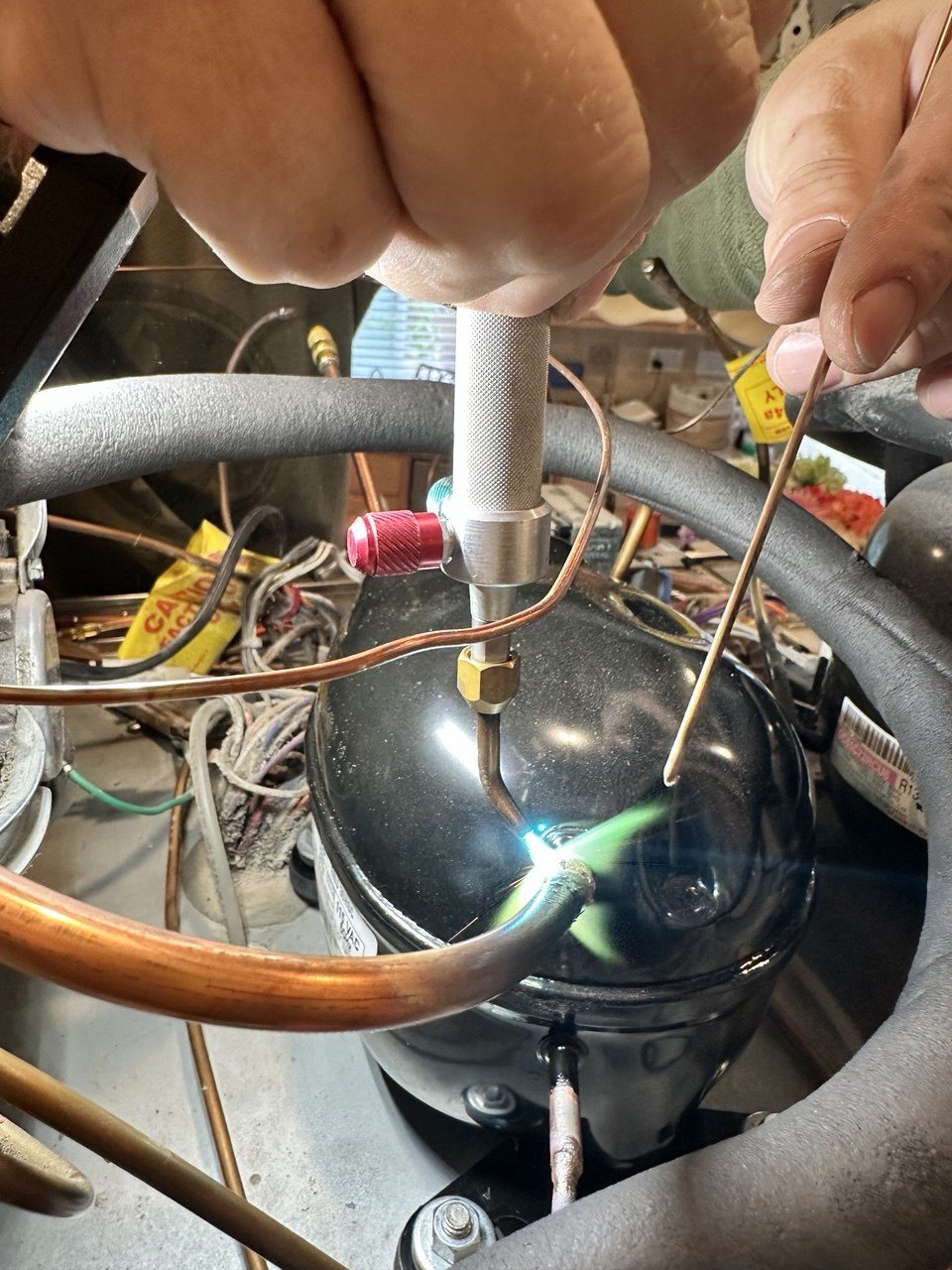
The expensive one, and the least common. The sealed system is the closed refrigerant loop: compressor, condenser, evaporator, and the lines between them. When it springs a slow leak, the charge drops, the compressor runs nonstop, and nothing brings temperature back.
Diagnosing it means reading refrigerant pressures with gauges and testing the compressor electrically. Repair means recovering the refrigerant, finding and fixing the leak, pressure-testing, pulling a vacuum, and recharging to spec. This is EPA Section 608 work with specialized gear. We carry that certification and do the work ourselves.
On a built-in Sub-Zero worth keeping, a sealed-system rebuild runs $1,400 to $2,800 depending on leak location. On an older or borderline unit we run the replace-versus-repair math with you first.
What it costs
| Repair | Typical range |
|---|---|
| Door gasket | A couple hundred, parts and labor |
| Condenser or evaporator fan motor | $300 to $600 |
| Defrost component (heater, thermostat, board) | $300 to $700 |
| Sealed-system rebuild | $1,400 to $2,800 |
The diagnostic is $75, credited to the repair when you move forward. After we look, you get a written repair-or-replace call and a price before anything past diagnosis happens. For the broader picture, see our Bay Area appliance repair cost guide.
Book a visit
Once you have run the basic checks and it still is not cooling, book. A Sub-Zero sitting warm is losing food and stressing the compressor, and there is no upside to waiting it out. Have the model and serial number ready (sticker inside the fresh-food compartment) so we carry the right parts.
Call (925) 999-4095 or use the form on the contact page. We work to get Bay Area calls scheduled fast, often same or next day when we can. We cover San Ramon, Danville, Alamo, Oakland, Fremont, and out across the Peninsula and South Bay.
Related: Sub-Zero brand page · Refrigeration repair service · Wine fridge and wine cooler repair · LG refrigerator not cooling in Danville
What sealed-system work looks like